
Mid & high-current potentiostats & Galvanostats (>100 mA)
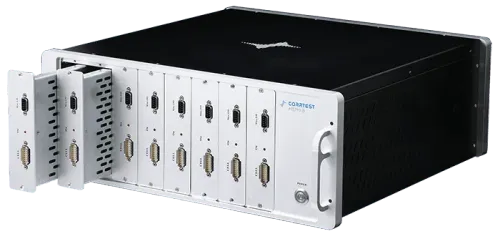
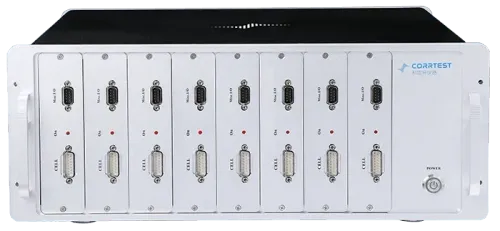
CS310X Multi-channel
Price on request


Price: On Request
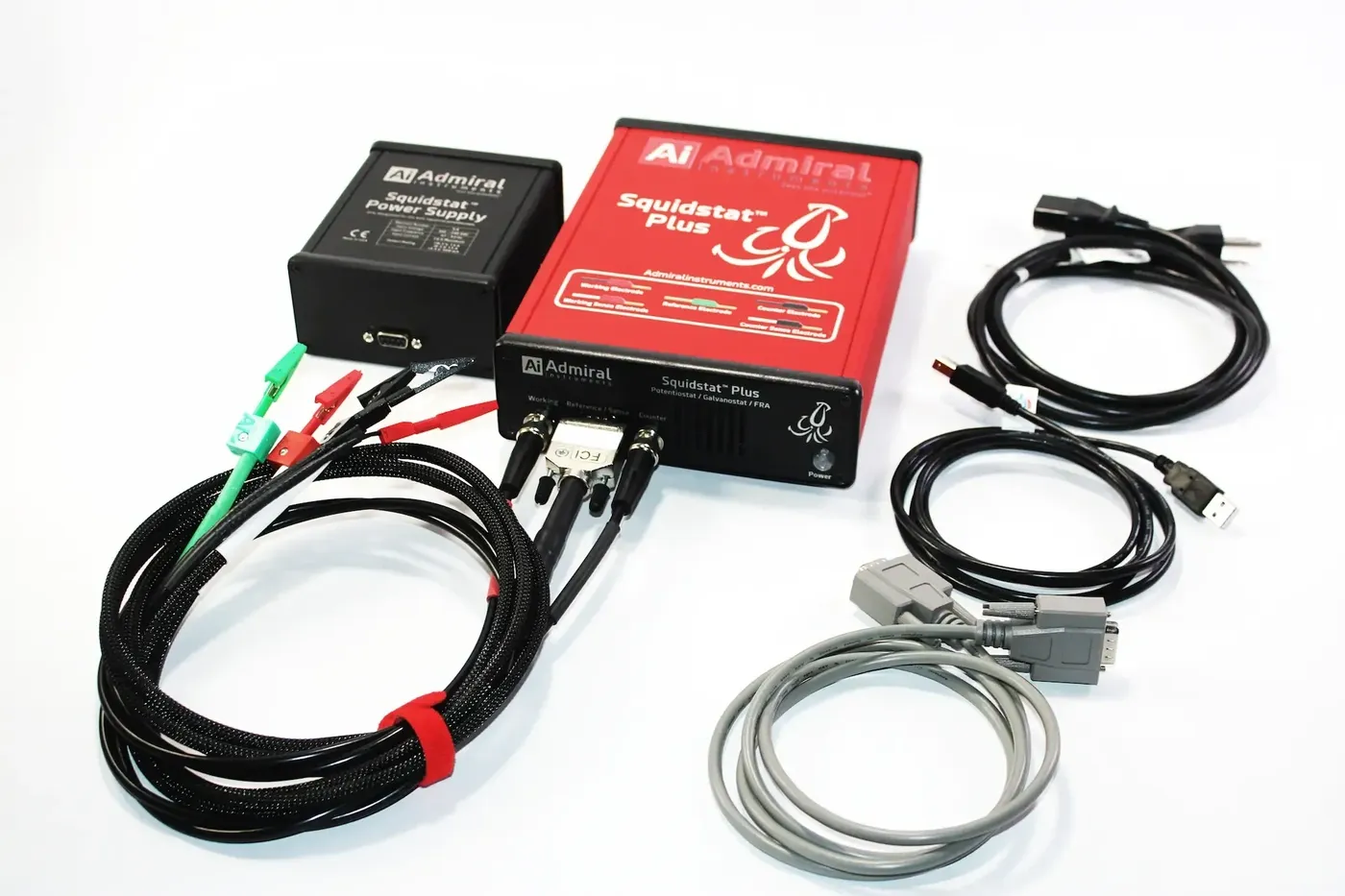
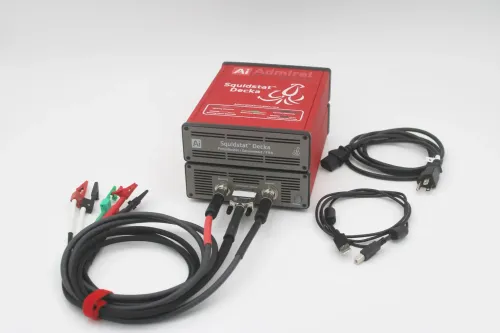
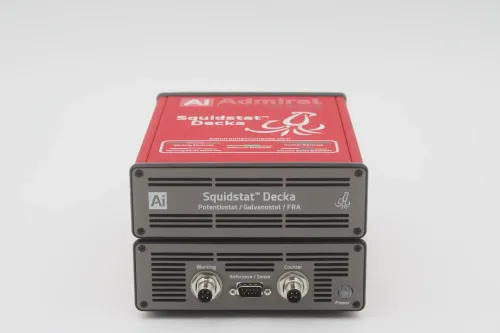
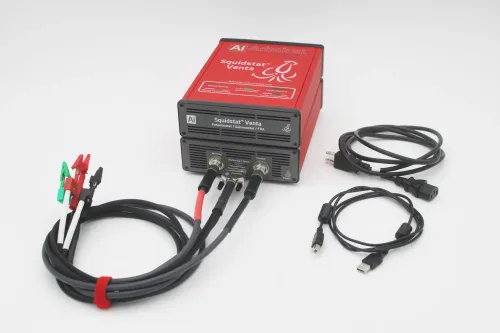
Squidstat Plus Complete Setup:
Single-channel potentiostat/galvanostat with FRA:
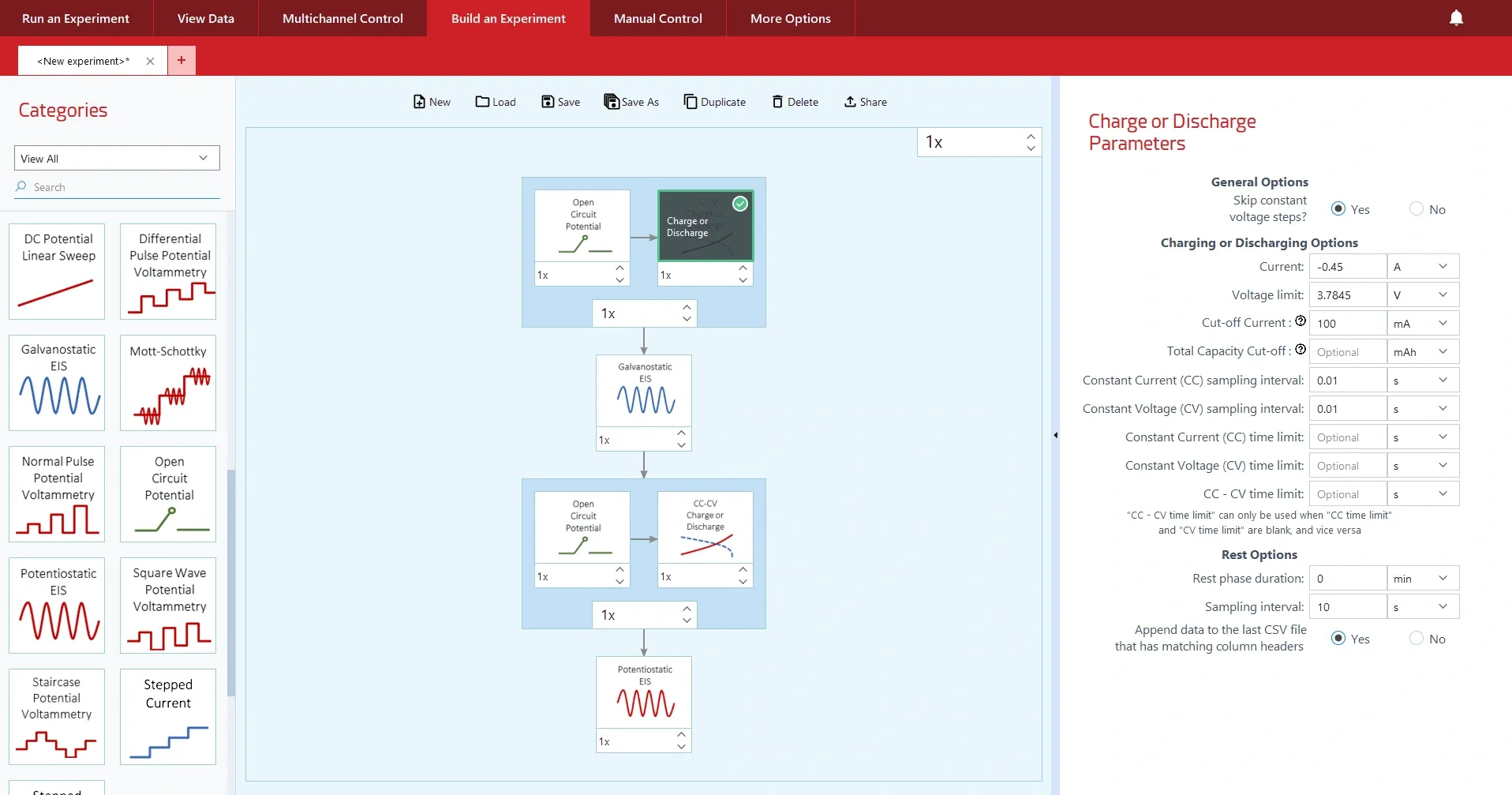
This system supports multiple electrochemical experiments. Please contact the vendor for the complete and up-to-date list of supported experiments.
Included:
Instrument Type
Potentiostat/Galvanostat
Weight
1 kg
Operating system
Linux, Windows, macOS
Dimensions
170 × 240 × 60 mm
Power supply
100–240 V AC, 50–60 Hz
Onboard data storage
16 GB
Max. channels
1
Instrument architecture
Single-channel, stackable
PC connection details
USB 2.0; one USB connection per unit
Operating modes
Potentiostatic, Galvanostatic, ZRA, FRA
ADC resolution
16 bit
Grounding details
Floating/Ground Mode Both (Switchable)
Shortest DC data recording interval
200 μs
DC hardware sampling
7.5 μs
Ambient temperature when measuring
0 °C to +40 °C
Channel Cable Length
1 m
Input impedance
10 Tera-Ω (typical)
Input Bias Current
10 pA (typical)
Cell connection
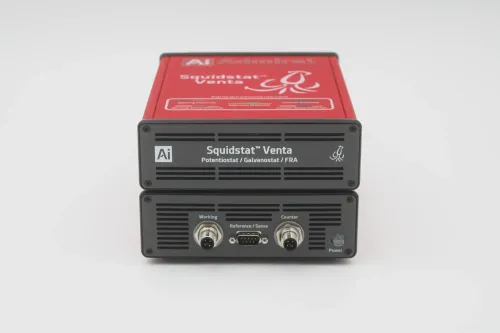
2, 3 or 4 electrodes; 5 leads (WE, WE-S, RE, CE, CE-S)
Applied potential resolution
0.003% (30.52 ppm) of range, 15 μV min
Min. Voltage resolution (output) / μV
15
Applied potential accuracy
0.1% of setpoint, 1 mV min
Measured potential resolution
0.003% (30.52 ppm) of range, 15 μV min
Min. Voltage resolution (input) / μV
15
Measured potential accuracy
0.1% of measured, 1 mV min
Scan rate
15 μV/s minimum & 25 V/s maximum with 10 mV sampling
Smallest Potential Step for Sweep Voltammetry
0.003% (30.52 ppm) of range, 15 μV min
Smallest Pulse Width
375 μs
Max. current (output) / A
±1 A
Current measurement ranges
8 ranges, [100 nA to 1 A]
Applied current resolution
0.003% (30.52 ppm) of range, 3 pA min
Applied current accuracy
0.2% of range, 1 nA min
Measured current resolution
0.003% (30.52 ppm) of range, 3 pA min
Min. Current Resolution (input) / pA
3
Measured current accuracy
0.1% of range, 100 pA min
Accuracy Contour Plot
See images
EIS Amplitude resolution
24-bit resolution
EIS frequency accuracy
0.005% (50 ppm) or better
EIS frequency resolution
18-bit, 0.0004% (3.81 ppm), 3 μHz min
Potentiostatic EIS Amplitude
≤ 100% of range, 10 V max
Potentiostatic EIS Amplitude Resolution
0.000012% (0.12 ppm) of setpoint/measured
Galvanostatic EIS Amplitude
≤ 100% of range, 1 A max
Galvanostatic EIS Amplitude Resolution
0.000012% (0.12 ppm) of range
EIS frequency range
10 µHz to 2 MHz
Max. EIS frequency range / MHz
Get pricing and product details from Admiral Instruments.
2 global ratings
Verified Identity
Every review undergoes an email verification process to ensure it originates from a verified industry professional.
Verified Purchase
We manually validate "Verified Purchase" claims by cross-referencing with supplier records or identifying the equipment in peer-reviewed scientific publications.
Transparent Publishing
All verified reviews, whether positive or negative, are published without bias as long as they comply with our community guidelines.
Digital-to-Analog Converters
16 bit
Form factor
Benchtop
Floating operation
Yes
Time Resolution
10 ns
iR compensation voltage limits
23.5% of range, 2.35 V max
Potential measurement ranges
4 ranges, [±10 V, ±5 V, ±1 V, ±0.5 V]
Slew rate
1 MV/s (-1 V to +1 V; 1 kΩ load)
Square Wave Voltammetry Max Frequency
3.5 kHz (-1 V to +1 V)
Compliance voltage
±12 V
Potential range
±10 V
2
Min. EIS frequency range / µHz
10
EIS configuration
Included
This potentiostat is a great purchase for any kind of laboratory. It is versatile, intuitive, compact, and offers complete functionality for electrochemical measurements. Given its price, it can be an excellent buy for a small laboratory just starting to carry out electrochemical measurements, as well as for a laboratory looking to expand its equipment.
After work for more than a decade using the main potentiostate brands (Biologic, Metrohm and Arbin) Admiral has been a very interesting finding. Squidstat plus has high specifications/price ratio and a software that is up to the task. The only point I think could be improved is the data processing/analysis once the test is finished (I have not yet found a potentiostate software that does this well).
Share your experience with this product.
Scientific publications where researchers have utilized this equipment.Are you an author? Contact us to add your research.
Cristiano Lo Pò, Stefano Boscarino, Francesco Ruffino • Micromachines, 2026, 17, 2, 249
https://doi.org/10.3390/mi17020249(opens in a new tab)Szu-Ying Li, Yun-Ting Kuo, Sheng-Huang Lin, Shun-An Kan, Bo-Wei Chen, Ssu-Ju Li, Ching-Wen Chang, Han-Lin Wang, Yu-Chun Lo, You-Yin Chen • ACS Chemical Neuroscience, 2026, 17, 16, 3122-3149
https://doi.org/10.1021/acschemneuro.6c00550(opens in a new tab)Bilawal Khan, M. Bilal Faheem, Karthik Peramaiah, Jinlan Nie, Hao Huang, Zhongxiao Li, Chen Liu, Kuo-Wei Huang, Jr-Hau He • Nature Communications, 2024, 15, 1, 6990
https://doi.org/10.1038/s41467-024-51088-0(opens in a new tab)Lianghao Deng, Chenyang Wang, Anqi Xu, Fanglin Zha, Tong Liu, Xuelei Hu, Yao Wang • Catalysts, 2024, 14, 10, 740
https://doi.org/10.3390/catal14100740(opens in a new tab)Yong Hu, Zipeng Guo, Yingjie Chen, Chi Zhou, Yuguang C. Li, Shenqiang Ren • Nature Communications, 2022, 13, 1, 7056
https://doi.org/10.1038/s41467-022-34874-6(opens in a new tab)Price on request

Price on request

Price on request

Price on request
Price on request
Price on request
Price on request

Price on request
Price on request
Price on request